

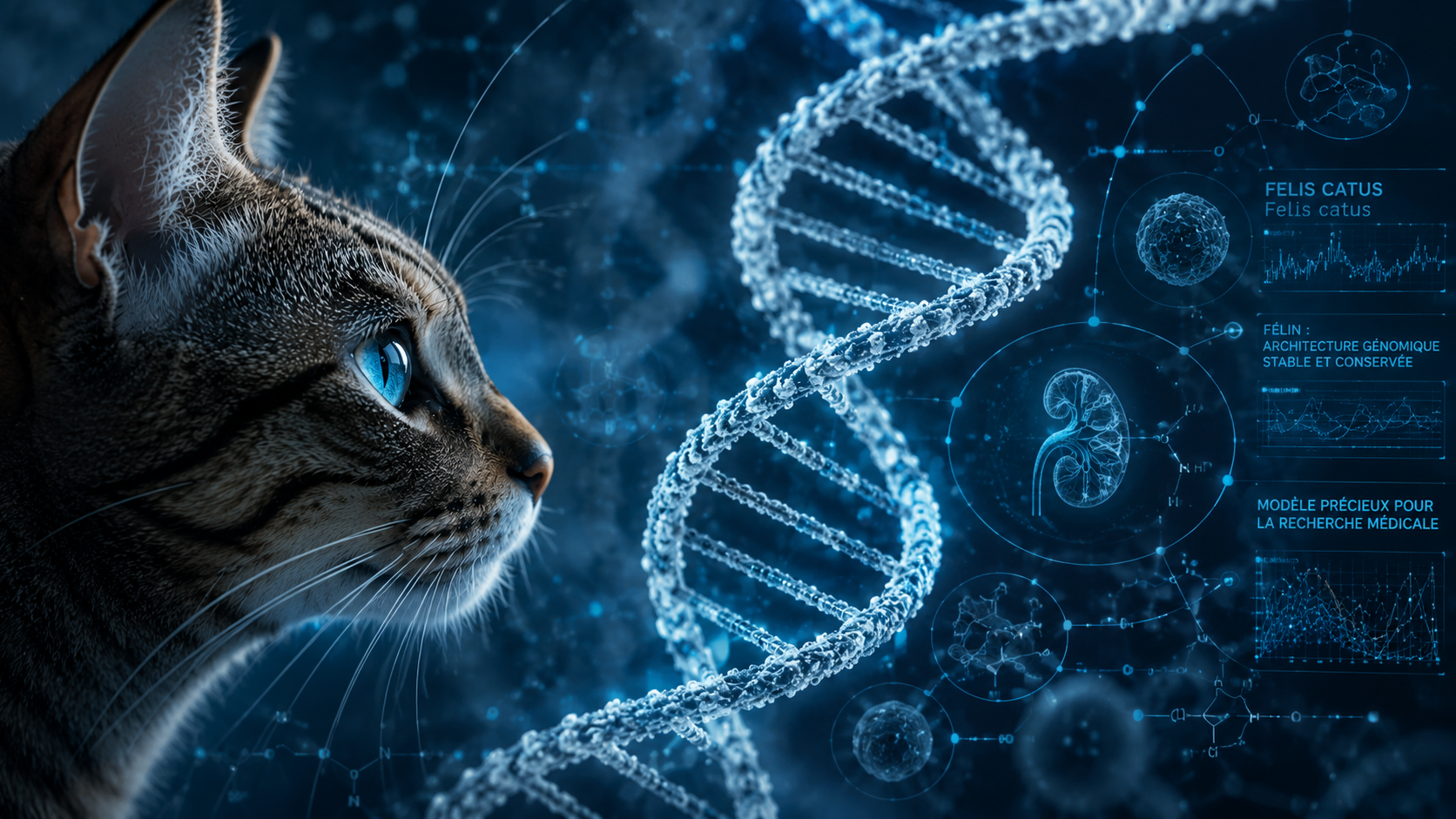
What if cats could help us better understand human diseases?
Why the feline genome is currently intriguing researchers in medicine and comparative genomics
Dogs are often thought of as the animals “closest” to humans.
Yet modern comparative genomics tells a much more nuanced—and fascinating—story.
According to research by geneticist William J. Murphy and several international teams specializing in mammalian evolution, the chromosomal architecture of cats is, in some respects, more conserved and more similar to that of humans than to that of dogs.*
Please note: This does NOT mean that we share more DNA with cats. This distinction is crucial.
What is at issue here is the organization of genes within chromosomes—what biologists call “conserved synteny.”
In other words: the arrangement of large genetic blocks in the feline genome more closely resembles that observed in humans.
Why?
Because the canid lineage has undergone, over the course of evolution, an extremely large number of chromosomal rearrangements: — breaks, — inversions, — fusions, — large-scale reorganizations.
In contrast, felines have maintained a remarkably stable genomic structure over millions of years.
A major publication by Fengtang YANG and colleagues in the journal *Chromosome Research* even describes the dog as having “one of the most rearranged mammalian karyotypes studied to date,” while the cat has a “highly conserved” karyotype. ()
Researchers have shown that it would take at least: — 47 chromosomal breaks, — 25 fusions, — and several inversions, to transform the chromosomal organization of a cat into that of a dog. ()
This genomic stability in cats is of great interest to evolutionary biologists.
This is because the physical organization of the genome directly influences: — gene expression, — certain epigenetic regulatory processes, — three-dimensional DNA interactions, — and, in some cases, susceptibility to certain diseases.
Researchers are particularly interested in a phenomenon known as “segmental duplications.”
In primates and several other mammals, these duplications promote chromosomal rearrangements. However, felines have far fewer of them.
Recent work by the Texas A&M University Feline Genomics Project suggests that this low density of duplications could explain the extraordinary stability of the feline genome. ()
Recent publication: New publication describes findings on cat evolution to aid future disease studies (2024)
And this isn't just an evolutionary curiosity. It could have major medical implications.
Cats spontaneously develop several diseases that are very similar to human conditions: — polycystic kidney disease, — certain cardiomyopathies, — retinal diseases, — neurological disorders, — cancers, — chronic inflammatory diseases.
In the case of polycystic kidney disease, for example, cats—particularly certain Persian breeds—have homologous mutations in the PKD1 gene, which is also involved in humans. ()
Reference: Sequencing the Genome of the Domestic Cat – National Human Genome Research Institute
The cat thus becomes an extremely valuable biological model: not an “artificial” model, but a spontaneous, living model that naturally possesses mechanisms similar to our own.
This is precisely what modern translational medicine is seeking today: models capable of faithfully reproducing actual human pathophysiology.
Current research in comparative genomics goes even further.
Some research teams are now studying the links between: — chromosomal breakage sites, — genetic instability, — and human cancers.
The regions involved in certain evolutionary rearrangements also appear to correspond to areas frequently implicated in human cancers. ()
Review Article: Genome Diversity and Karyotype Evolution in Mammals
In other words: Understanding how genomes reorganize themselves over the course of evolution could also help us understand why certain human tissues become unstable or develop into tumors.
We are entering an era of medicine in which evolution, structural genomics, epigenetics, and comparative physiology are finally converging.
And sometimes…
The answers can be found in unexpected places: like in a cat's eyes.
Additional scientific sources:
— Evolution of Mammalian Genome Organization Inferred from Comparative Gene Mapping — Conservation of Chromatin Conformation in Carnivores — The Feline Genome Project — William J. Murphy – Scientific Work and Publications