

Tomato Recall at Carrefour: Datura, a Toxic Plant with Sometimes Serious Neurological Effects
Hallucinations, vision problems, rapid heartbeat… Behind the recall of ordinary canned tomatoes lies a little-known risk: datura, a wild plant whose toxic substances can profoundly disrupt the body’s normal functioning.
Can a simple can of tomatoes be dangerous?
Imagine for a moment…
You’re calmly preparing a homemade tomato sauce. A few vegetables, some fresh herbs, a can of peeled tomatoes… Familiar ingredients that evoke simple, flavorful, and comforting home cooking.
However, some foods may pose a danger that is completely invisible to the naked eye.
This is precisely what a health alert issued in September 2026 regarding canned tomatoes sold at Carrefour reminds us.
The issue? The possible presence of datura seeds, a wild plant that is naturally rich in toxic substances capable of disrupting the functioning of the nervous system.
This event deserves our attention—not to cause alarm, but to better understand food safety risks and adopt the right preventive measures.
Because beyond this current issue, a fundamental question arises: Do we really know which natural substances are capable of contaminating our food?
1. Which tomatoes are affected by this recall?
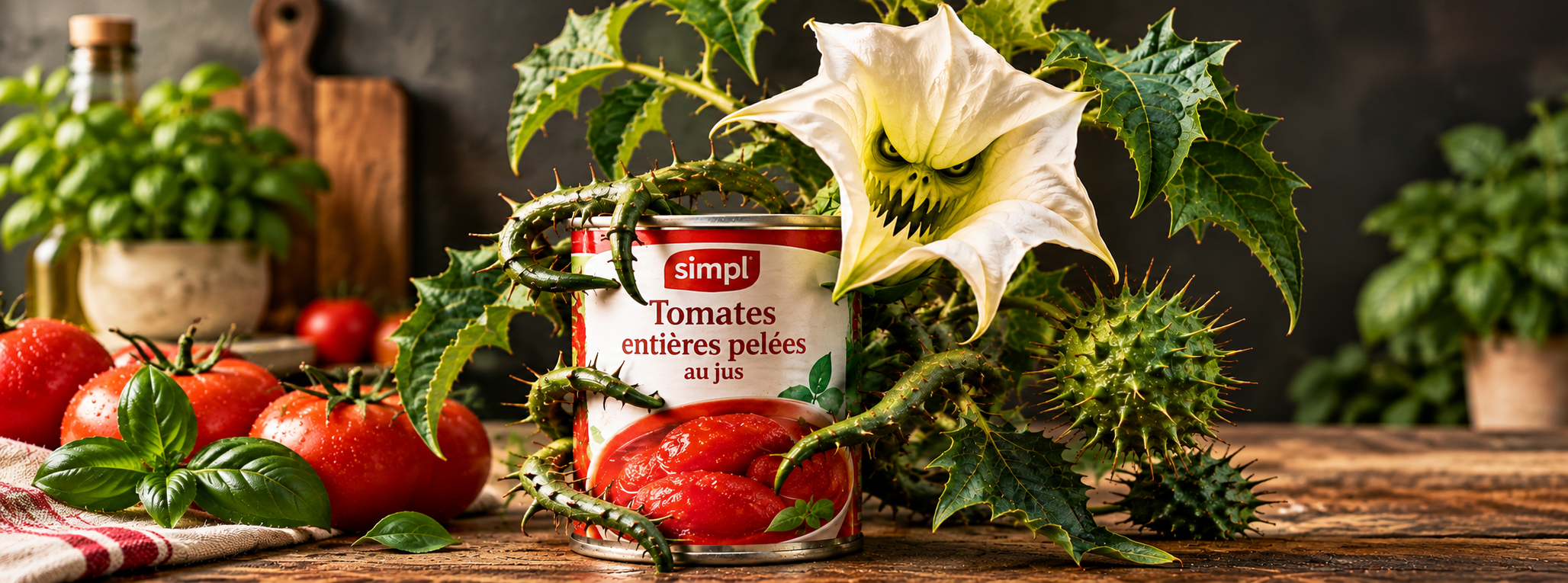
According to information previously posted on the government platform RappelConso, the recall involves a specific lot of SIMPL brand whole peeled tomatoes in juice, sold at Carrefour in France.
Part numbers for the product in question:
-
️ Brand: SIMPL
-
Product: Whole Peeled Tomatoes in Juice
-
Packaging: 800-gram can
-
Lot number: L25252
-
Barcode: 3560070479467
-
Best-by date: December 31, 2028
-
Sales period: April 7 through September 17, 2026
-
Sales area: All of France
⚠️ Important: This alert applies to the identified batch and not to all tomato cans sold by Carrefour.
If you have this product, do not consume it and review the official recall procedure at https://rappel.conso.gouv.fr/.
The details and practical arrangements for the recall must be confirmed on the official form before taking any action.
2. Datura: a wild plant with extreme toxicity
Datura, particularly Datura stramonium, belongs to the Solanaceae family, just like tomatoes, eggplants, and potatoes.
But be careful: this botanical relationship does not in any way mean that these plants have the same properties!
Datura contains naturally toxic substances called tropane alkaloids, which include:
-
Hyoscyamine, of which atropine is the racemic form.
-
Scopolamine.
-
Other alkaloids are present in varying proportions depending on the plant and its growing conditions.
These molecules have potent pharmacological activity and can cause serious poisoning.
How can this plant contaminate our food?
Datura grows wild in certain agricultural areas.
Its seeds or plant fragments may accidentally end up mixed in with crops during harvesting, sorting, or processing.
This phenomenon has been particularly well documented in certain cereal and crop sectors.
It is therefore not necessarily a substance intentionally added to a food product, but rather accidental botanical contamination.
This risk underscores the importance of crop monitoring, raw material sorting, and pre-market inspections.
Scientific reference: EFSA CONTAM Panel, 2013 — Scientific Opinion on Tropane Alkaloids in Food and Feed.
https://doi.org/10.2903/j.efsa.2013.3386
3. Why can datura cause hallucinations?
To understand the effects of datura, let's take a closer look at a key player in our physiology: acetylcholine.
This neurotransmitter plays a role in many of our body's functions:
-
The transmission of nerve signals.
-
Certain cognitive functions, particularly attention and memory.
-
Regulation of heart rate.
-
Digestion.
-
How the Eye's Muscles Work.
-
The regulation of certain bodily secretions.
The tropane alkaloids found in datura block the action of acetylcholine on certain receptors, known as muscarinic receptors.
This mechanism, known as the antimuscarinic effect, can simultaneously disrupt several physiological functions.
All of these symptoms together constitute what doctors call an anticholinergic syndrome.
️ Visual disturbances that can sometimes be quite striking
The pupils may dilate significantly, causing blurred vision, increased sensitivity to light, and difficulty focusing.
Alarming neurological symptoms
Poisoning can cause unusual agitation, confusion, disorientation, hallucinations, or delirium.
These symptoms can be particularly unsettling for the person affected and those around them.
❤️ Cardiovascular disorders
The heart rate may increase, sometimes significantly. This condition is called tachycardia.
️ Disorders of body regulation
Severe dry mouth, decreased sweating, skin redness, and an increase in body temperature may also occur.
⚠️ In severe cases, poisoning can cause serious neurological and cardiovascular complications that require urgent medical attention.
The severity depends, in particular, on the amount of substances absorbed, their concentration, and individual sensitivity.
Scientific reference: Fatur K., Kreft S., 2020 — Common anticholinergic solanaceous plants of temperate Europe — A review of cases of poisoning from the literature (1966–2018).
Toxicon, 177, 52–88.
https://doi.org/10.1016/j.toxicon.2020.02.005
4. Is cooking enough to eliminate the danger?
This is a particularly relevant question, since peeled tomatoes are generally used in stews.
We naturally tend to think that cooking food for a longer time makes it safer.
And this is indeed the case for many pathogenic microorganisms.
However, chemical contaminants of plant origin do not necessarily react to heat in the same way.
Tropane alkaloids exhibit varying degrees of stability depending on temperature, the duration of heat treatment, pH, and the composition of the food.
What do scientific studies show?
A study published in 2024 in *Food Research International* examined the influence of temperature and pH on various tropane alkaloids.
In particular, the researchers evaluated their behavior in a cereal matrix that had been subjected to heat treatments.
Their findings show that certain processing conditions can reduce the concentrations of these substances, but that a significant portion may remain.
These observations do not allow us to determine precisely what happens in a can of tomatoes simmered at home. They do, however, show that it would be unwise to consider cooking a reliable method of decontamination.
Simmering a can of food subject to this recall for several hours does not guarantee that it is safe to eat.
Similarly, removing the visible seeds does not guarantee that the rest of the preparation is free of toxic substances.
The only appropriate course of action is to refrain from consuming the recalled product.
Scientific reference: Torrents-Masoliver B. et al., 2024 — Effect of pH and temperature on tropane alkaloids in a processing strategy to provide safe infant cereal-based food.
Food Research International, 188, 114439.
https://doi.org/10.1016/j.foodres.2024.114439
5. Natural doesn't always mean harmless!
That is probably one of the most important lessons to be learned from this case.
We often associate the word “natural” with concepts such as purity, balance, and well-being.
However, nature also produces substances that are highly biologically active, some of which can be extremely toxic.
Datura is a particularly striking example of this.
Certain plant-derived molecules have therapeutic applications when used under strictly controlled medical conditions.
However, a natural substance can become dangerous when its dosage, method of use, or exposure are not properly controlled.
⚖️ It's all about the substance, the dose, and the context
In toxicology, several factors determine the risk:
-
The nature of the substance.
-
His concentration.
-
The amount absorbed.
-
Route and duration of exposure.
-
Age and individual sensitivity.
-
Possible interactions with medications or other substances.
When it comes to health, whether a substance is natural or synthetic is never enough to determine its safety.
This discussion applies to our diet as well as to medicinal plants and dietary supplements.
A responsible approach to health must therefore combine scientific knowledge, an understanding of physiological mechanisms, and a rigorous risk assessment.
6. Is there a dose considered safe?
The European Food Safety Authority (EFSA) has examined the risks associated with dietary exposure to tropane alkaloids.
In its 2013 assessment, it established an acute reference dose of 0.016 micrograms per kilogram of body weight for the sum of hyoscyamine and scopolamine.
This value serves as a benchmark in food risk assessment.
It should not be interpreted as a recommended amount to consume, nor as an absolute guarantee of the absence of symptoms.
Nevertheless, it illustrates the biological potency of these molecules, for which even very low levels of exposure may already be of toxicological interest.
The acute reference dose does not constitute a threshold for determining whether a recalled canned product is safe to eat.
Scientific reference: EFSA CONTAM Panel, 2013 — Scientific Opinion on Tropane Alkaloids in Food and Feed.
EFSA Journal, 11(10), 3386.
https://doi.org/10.2903/j.efsa.2013.3386
️ 7. What should you do if you've bought these tomatoes?
If you find a can that matches the recall details, here are the essential precautions to take.
✅ Check the product part numbers
Compare the lot number, barcode, and best-by date with the information provided by RappelConso.
⛔ Do not consume the product in question
Even if it looks, smells, or tastes perfectly normal, it should not be used.
Follow the recall procedure
Follow the instructions provided on the official form for returning the product, obtaining a refund, or having it destroyed.
☎️ If ingested, contact a poison control center immediately
It is recommended to seek expert advice even if no symptoms have appeared yet.
If possible, keep the packaging and product information on hand to facilitate the assessment of exposure.
If you experience severe symptoms, call emergency services immediately
Confusion, hallucinations, severe dizziness, or heart problems require urgent medical evaluation.
In France and Luxembourg, the European emergency number is 112.
⚠️ Do not induce vomiting, and do not attempt to neutralize toxic substances with home remedies.
8. A Naturopath’s Perspective: Understanding to Better Prevent
In my practice of functional naturopathy and micronutrition, I place particular emphasis on the quality of our diet and on understanding the interactions between our environment and our bodies.
We regularly discuss the nutritional benefits of foods, including their high content of vitamins, minerals, antioxidants, and other bioactive compounds.
But food quality is not limited to its nutritional value alone.
It also includes:
-
Growing and Harvesting Conditions.
-
The quality of the raw materials.
-
Monitoring for contaminants.
-
Processing methods.
-
️ The safety of finished products.
The datura case reminds us that a healthy diet also depends on a nuanced understanding of foods and their environment.
The point is not to become overly suspicious of what we eat, but rather to learn to distinguish between genuinely documented risks and unfounded concerns.
A balanced, varied diet tailored to individual needs remains essential.
However, it must be accompanied by reliable information and appropriate preventive measures.
Because taking care of your health also means knowing how to recognize situations in which caution is essential.
An individualized approach based on understanding
Each organism has its own physiological characteristics, nutritional needs, and factors that make it vulnerable.
That is why I place great importance on listening, analyzing each person's individual circumstances, and providing information that is easy to understand.
My goal is to help you gain a better understanding of your body and your lifestyle, so that you can make informed and sustainable choices.
This preventive measure complements public health recommendations. It is never a substitute for medical care when poisoning or a medical emergency is suspected.
In conclusion: vigilance, without worry
This alert regarding canned tomatoes highlights a relatively little-known food safety risk: accidental contamination by naturally toxic plants.
This should not lead us to question all canned tomatoes, but rather to better understand the importance of health inspections and recall procedures.
Scientific research now allows us to better identify the mechanisms of datura toxicity, understand its neurological and cardiovascular effects, and recognize the limitations of thermal treatments in removing certain contaminants.
It only takes a few minutes to check a product's details and share useful information with friends and family.
And sometimes, even a simple action like that can help prevent poisoning.
Take care of yourselves, and feel free to share this article with your loved ones. Reliable information deserves to be shared!
Scientific Studies and Bibliographic References
1. EFSA CONTAM Panel (2013)
Scientific Opinion on Tropane Alkaloids in Food and Feed.
EFSA Journal, 11(10), 3386.
European scientific assessment of the risks associated with tropane alkaloids in food, particularly hyoscyamine and scopolamine.
https://doi.org/10.2903/j.efsa.2013.3386
2. Torrents-Masoliver, B., et al. (2024)
Effect of pH and temperature on tropane alkaloids in a processing strategy to produce safe infant cereal-based foods.
Food Research International, 188, 114439.
An Experimental Study on the Influence of Temperature and pH on the Stability of Tropane Alkaloids in a Cereal Matrix.
https://doi.org/10.1016/j.foodres.2024.114439
3. Fatur, K., Kreft, S. (2020)
Common Anticholinergic Solanaceous Plants of Temperate Europe — A Review of Poisonings from the Literature (1966–2018).
Toxicon, 177, 52–88.
A scientific journal devoted to cases of poisoning caused by various anticholinergic plants of the Solanaceae family, including datura.
https://doi.org/10.1016/j.toxicon.2020.02.005
4. Scientific Review on Datura stramonium Poisoning (2025)
Datura stramonium — A Dangerous Weed and Alternative Drug of Abuse: An Overview of Poisoning Cases in the 21st Century.
A review of published cases of poisoning in the 21st century, including various circumstances of exposure.
https://pubmed.ncbi.nlm.nih.gov/40086888/
️ 5. RappelConso — Official French Source
Government platform for recalls of products that pose a risk to consumer health or safety.
Scientific note: The studies presented explain the mechanisms of datura toxicity and the risks associated with tropane alkaloids. They do not constitute direct analyses of the batch of tomatoes recalled in September 2026.
This article is provided for informational and preventive purposes.
It is not a substitute for medical advice, consultation with a poison control center, or appropriate medical care.