

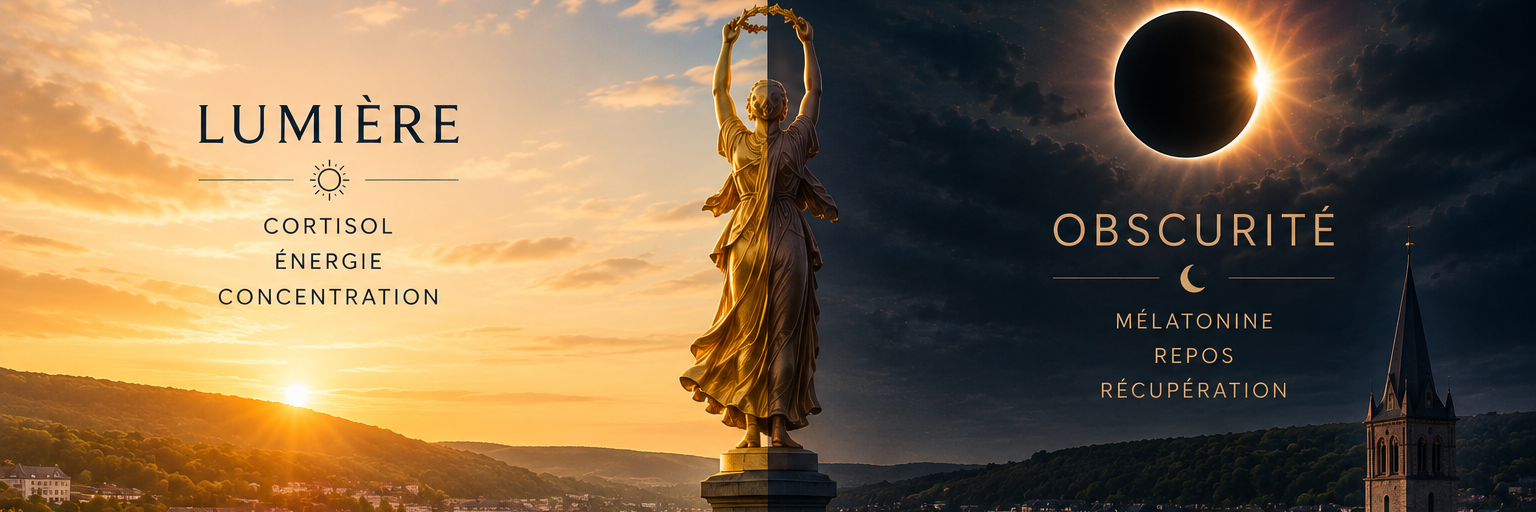
Solar eclipse in Luxembourg: What if a few minutes of darkness reminded us just how much our health depends on light? ...
On Wednesday, August 12, 2026, Luxembourg will witness an exceptional astronomical phenomenon.
In Ettelbruck, Solar Eclipse Day 2026 will bring the public together to witness a deep partial solar eclipse.
For nearly two hours, something unusual will happen around us: as the summer day draws to a close, the light will gradually change.
At approximately 7:20 p.m., the eclipse will begin in Ettelbruck.
At around 8:14 p. m., it will reach its peak: nearly 89.5% of the solar disk will be obscured.
Then the Sun will gradually reappear, until the phenomenon ends around 9:06 p.m.
A rare sight.
But above all, it’s a wonderful opportunity to focus on something that’s much less spectacular and yet essential to our health:
the light.
Because our eyes aren't just for seeing.
The light that reaches our retina also transmits information to our brain and helps synchronize our biological clock.
Sleep, wakefulness, alertness, melatonin, cortisol…
Our bodies operate in sync with the cycle of day and night.
What if this eclipse gave us just the right opportunity to rediscover that rhythm?
But what does an eclipse have to do with our health?
None, directly.
And that clarification is important.
There is no serious scientific basis for claiming that the eclipse on August 12 will suddenly alter your hormones, “detoxify” your body, or disrupt your energy.
On the other hand, an eclipse allows us to observe something we rarely notice:
a change in natural light.
And that's where the connection to our physiology gets really fascinating.
Our bodies have biological rhythms, some of which follow a cycle of approximately 24 hours: these are known as circadian rhythms.
The sleep-wake cycle is probably the best-known example of this.
But our biological clock plays a much broader role in the temporal organization of our physiology.
And one of the main signals that allows this internal clock to synchronize with our environment is extraordinarily simple:
the alternation between light and darkness.
Your eyes aren't just for seeing
When light enters the eye, it obviously enables vision.
However, certain specialized cells in the retina also play a role in transmitting light-related information to the brain structures involved in circadian regulation.
In other words, your brain uses light as a kind of temporal reference point.
It includes:
"It's daylight."
Then:
"The day is moving along."
And, when the light dims:
"Night is falling."
Light thus has effects that go far beyond vision and plays a role, in particular, in circadian rhythms, sleep, and alertness.
This is so important that an international scientific consensus published in PLOS Biology now recommends getting enough light during the day, significantly reducing light exposure in the hours before bedtime, and keeping the sleep environment as dark as possible.
In the morning: Your body needs to realize that the day is beginning
Now imagine two alarm clocks.
In the first case:
You get up, open the shutters, step outside for a few moments, walk to your car, take the kids to school, or have breakfast by a window that’s wide open to the outdoors.
In the second one:
You wake up in a dark room, eat breakfast under artificial lighting, get in your car, and then spend the day in an office.
The time displayed on your phone may be exactly the same.
But your lighting environment isn't.
For millennia, our days have been naturally structured by a very distinct alternation:
A lot of light during the day, very little at night.
Today, we can experience exactly the opposite:
Not enough natural light on some days… and way too much light on some evenings.
That is why regularly spending time outdoors in natural light, especially in the morning, is an extremely beneficial habit.
Under no circumstances should you look directly at the Sun.
It's simply a matter of seeing the light again.
Melatonin: Why Our Bodies Also Need Nighttime
We talk a lot about light.
But much less of the darkness.
Yet this, too, constitutes a piece of information.
As the evening progresses and the light fades, our physiology gradually adjusts to nighttime.
Melatonin plays a role in this circadian rhythm and normally increases in the evening.
But our modern environment has profoundly altered this transition.
Phone.
Tablet.
Television.
Computer.
Powerful interior lighting.
Today, we can artificially extend the day until very late at night.
Our brain knows perfectly well that it's 11 p.m. when we look at the clock.
Our circadian system, for its part, relies primarily on light to determine where it is in the day.
Current scientific recommendations therefore point in a particularly interesting direction:
More light during the day, much less in the evening, and a room that is as dark as possible while sleeping.
What about cortisol?
Cortisol has a somewhat unfair reputation.
It is often described simply as “the stress hormone.”
That's far too simplistic.
Cortisol also follows a physiological circadian rhythm.
In a person with a typical sleep-wake cycle, these concentrations fluctuate throughout the day and play a key role in the mechanisms associated with wakefulness and the body’s adaptation.
This is a fundamental concept when considering functional health:
A biological value cannot always be understood independently of the time at which it is measured.
In physiology, the question is therefore not just:
"How much?"
It can also be:
"When?"
Light, sleep, energy: What if we started with the basics?
Feeling tired upon waking up.
Difficulty falling asleep.
Waking up in the middle of the night.
Daytime drowsiness.
Gradual delay in bedtime.
Before automatically looking for complex solutions, it may be helpful to observe the environment in which our body is trying to function.
Just ask yourself a few questions.
What time do you actually see the light outside in the morning?
How much time do you spend outdoors each day?
Is your home still very bright in the evening?
Do you look at a screen right up until bedtime?
Is your room really dark?
These questions seem almost too simple.
And yet, they directly affect the signals that our biological clock uses every day.
And what about vitamin D in all of this?
Sunlight and vitamin D are often linked.
And rightly so.
But we need to distinguish between two different phenomena.
The light that reaches our eyes helps synchronize our circadian rhythm.
The synthesis of vitamin D in the skin depends, in particular, on the skin's exposure to UVB radiation.
Many factors influence this synthesis: season, time of day, cloud cover, skin pigmentation, age, and the area of skin exposed.
And here's a little-known fact:
The UVB rays needed for this synthesis do not pass through glass.
Sitting by a sunny window and actually being outdoors are therefore not the same thing when it comes to the skin’s synthesis of vitamin D.
Of course, this doesn't mean we should expose ourselves indiscriminately.
Ultraviolet radiation can also damage the skin.
Once again, in physiology, more isn't necessarily better.
The Paradox of Modern Life
That may be the most interesting lesson we can learn from this eclipse on August 12.
We've managed to almost completely eliminate nighttime from our lives.
We can work at midnight.
Watching a TV series at 2 a.m.
Shopping under artificial lighting.
Check our phone in the middle of the night.
Then spend the next day in artificially lit buildings.
We have gained tremendous freedom.
But our physiology, for its part, remains deeply rhythmic.
One day should be like another.
And the night should still feel like night.
7 Simple Habits to Help You Regain Your Day-Night Rhythm
You can start by taking a look at your daily routine and trying out a few simple changes:
1. Get some outdoor light in the morning.
Open the shutters and, when possible, spend a few minutes outside.
2. Make sure to get outside during the day as well.
A walk, lunch outdoors, or a few short walks will help you get regular exposure to natural light.
3. Avoid spending your entire day in a uniformly lit environment.
Our natural environment is much brighter during the day than at night.
4. Gradually dim the lights in the evening.
Your home doesn't necessarily need to be as brightly lit as an office at 10 p.m.
5. Reduce the brightness of very bright screens before bedtime.
And if you do use them, at the very least, avoid setting the brightness to maximum in a dark room.
6. Make sure your bedroom is truly dark.
Night lights, the phone, outdoor lighting, the TV on standby: take a look at your bedroom once all the lights are off.
7. Try to maintain a relatively regular schedule.
Light, activity, meals, bedtime, and wake-up time serve as different time cues for our bodies.
These are not treatments.
These are environmental conditions that are more in line with our physiology.
Warning: Never look at an eclipse with regular sunglasses.
On August 12, one precaution is absolutely essential.
Never look directly at the Sun without protection specifically designed for solar observation.
In Luxembourg, the eclipse will be partial; therefore, there will be no time when it is safe to look directly at the Sun without protection.
Regular sunglasses—even very dark ones—aren't enough.
For direct viewing, use eclipse glasses or a solar viewer that complies with the international standard ISO 12312-2.
And be careful with electronic devices as well:
Binoculars, telescopes, and camera lenses concentrate sunlight and require their own specialized solar filters, which are placed in front of the optics.
Ettelbruck's Solar Eclipse Day is designed to provide a safe opportunity to observe the sun and offer explanations to the public.
From the Sun to the Perseids: Our Bodies Need Both
And then, around 9:06 p.m., the eclipse will end.
But the party will go on.
Solar Eclipse Day will continue until 1 a.m., with a focus on stargazing and the Perseids.
I find this transition particularly beautiful.
We'll start by looking at the Sun.
Then we'll wait until nightfall to look at the stars.
Light and darkness.
Two states that we often contrast.
These are two pieces of information that our organization does, however, need.
An eclipse lasting a few minutes. Your 24-hour biological clock.
On Wednesday, August 12, if you're in Luxembourg, look up at the sky over Ettelbruck.
With the proper protective gear, of course.
Watch this light change.
Come enjoy this science event for the whole family.
Let yourself be amazed.
Then, on Thursday morning, when the sun rises again as if nothing had happened, try something.
Go outside for a few minutes.
Look at the morning light.
Take a breath.
Walk.
And ask yourself:
"How much room do I still make for daylight in my days?"
Then, when evening came:
"How much room do I really make for the night?"
Because an eclipse is rare enough that we’d go out of our way to watch the light disappear for a few minutes.
But perhaps it can also remind us of something much simpler:
Our body, for its part, follows the cycle of day and night every day of our lives.
Practical Information – Solar Eclipse Day 2026
Date: Wednesday, August 12, 2026
Event hours: 5:00 p.m. – 1:00 a.m.
Location: Hall du Deich, Ettelbruck
Admission: free
Eclipse in Ettelbruck: approximately 7:20 p.m. – 9:06 p.m.
Maximum: approximately 8:14 p.m.
Maximum occultation: approximately 89.5%
Sources
Nightwise Luxembourg – Solar Eclipse Day 2026
https://nightwise.lu/solar-eclipse-2026/
Timeanddate – Solar Eclipse on August 12, 2026, in Luxembourg
https://www.timeanddate.com/eclipse/in/luxembourg?iso=20260812
Brown, T.M., et al. – Recommendations for daytime, evening, and nighttime indoor light exposure to best support physiology, sleep, and wakefulness – PLOS Biology, 2022
https://pmc.ncbi.nlm.nih.gov/articles/PMC8929548/
National Institutes of Health – Office of Dietary Supplements – Vitamin D
https://ods.od.nih.gov/factsheets/VitaminD-HealthProfessional/
NASA – Eclipse Viewing Safety
https://science.nasa.gov/eclipses/safety/
NASA – Total Solar Eclipse on August 12, 2026
https://science.nasa.gov/eclipses/future-eclipses/total-solar-eclipse-on-august-12-2026/
This article is intended to provide information and promote prevention. It is not a substitute for medical advice or individualized care.